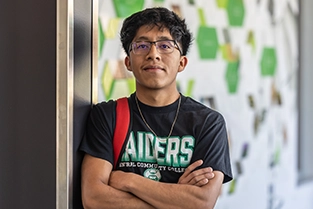
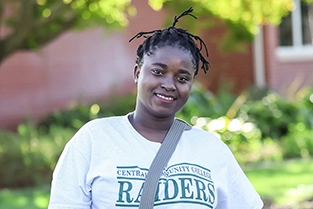
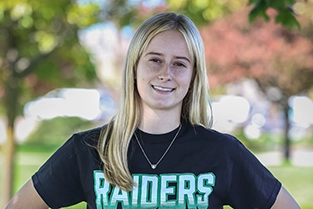
Welcome to Disability Services at Central Community College. We are proud to be an educational institution that welcomes and supports all of our student body. Disability Services provides a wide array of accommodations for students with physical, psychological, medical or learning disabilities. We welcome students to register and request accommodations.
Disability Services requires documentation of a disability to support the need for specific accommodations and to assist in determining individual needs. Students are expected to provide current documentation of their disability.
Documentation may include an IEP, MDT, 504 Plan, or documentation from the treating medical provider, and must, at a minimum, include a statement of diagnosis, length of treatment for the diagnosis, functional limitations in activities of daily living, prescribed medications and any other pertinent information.
Should your provider need guidance in writing a statement of your disability and need for accommodations, follow the Guidelines for Providers Submitting Documentation (PDF).
Accommodations are not retroactive, so it is important to set up services as early as possible to secure all necessary accommodations.

All students start the process of applying for accommodations through the online Disability Services Point-and-Click Portal. Disability Services will communicate with you through this portal to set up appointments and respond to your messages.
Please check the portal regularly for messages and information. If you wish to speak directly with a Disability Services Director, our contact information is located at the bottom of this webpage.
This procedure allows for equitable resolution of complaints by students with disabilities who allege violations of their rights under the ADAAA and Section 504 of the Rehabilitation Act within a reasonable time.
If you believe you have been discriminated against, want to appeal the approved accommodations or have other concerns related to Disability Services, contact Central Community College’s ADA coordinator for procedures that provide for prompt and equitable complaint resolution.
Luz Colon-Rodriguez, LIMHP, LPC
Director of Counseling and Prevention Education Services
504 Coordinator
402-562-1281
Email Luz
Assurance of equal educational opportunity rests upon legal foundations established by federal law, specifically the Rehabilitation Act of 1973, including Section 504, and the Americans with Disabilities Act of 1990, as amended in 2008.
Federal statutes govern the rights of individuals with disabilities.
Section 504 of the Rehabilitation Act of 1973 (Section 504) states that no “otherwise qualified person” with a disability can be excluded from, denied the benefits of or be subjected to discrimination under any program or activity within an institution that receives federal financial aid.
The Americans with Disabilities Act (ADA) (as amended, 2008) defines a person with a disability as any individual who has a physical or mental impairment that substantially limits one or more major life activities; has a record of such an impairment; or is perceived by others as having such an impairment.
Taken together, Section 504 and the ADA (and ADAAA) require institutions of higher education to provide equal access to educational opportunities to otherwise qualified persons with disabilities.
Reasonable accommodation in college programs and services (auxiliary aides and services and academic adjustments) enable qualified students with disabilities to have equal access to those programs and services and equal opportunity to benefit from them.
A student is a person enrolled at the college.
A qualified student is one who, with or without reasonable accommodations, meets the academic and technical standards required for admission to, participation in and/or fulfilling the essential requirements of college programs or activities and who has provided appropriate documentation of his/her disability.
A student with a disability has a physical, mental or sensory impairment that substantially limits one or more of his/her major life activities; has a record of such an impairment; or is regarded as having a disability.
High school students who enroll in Early College courses are eligible to receive academic accommodations. Students may take a course in their own high school classroom, online or at one of our campuses or centers.
Regardless of where the course is taken, if it is for college credit, the student will need to register with the Central Community College (CCC) Disability Services office and request CCC accommodations.
For students interested in applying for accommodations, please visit our Disability Services Point-and-Click portal.
For Early College Courses, the student follows the Central Community College process, which includes:
No. For Early College Courses, it is important to remember that the IEP and the high school 504 plans do not carry over to college. Some accommodations provided at the high school may also be appropriate at the college level.
However, in high school, supports and services may go beyond a reasonable accommodation because they would modify the learning objectives and outcomes.
College curriculum is not modified for any student, with or without disabilities.
No. For Early College Courses, the IEP team plays a key role in providing recommendations and documentation for requested accommodations in high school. The Disability Services Office at Central Community College will make decisions about accommodations for college classes. Teachers should not use the high school IEP or 504 plan interventions in any early college class and instead should refer to the CCC Accommodation Letter.
Commonly considered reasonable accommodations in college: note-taking assistance, including smart pens and audio recorders; testing accommodations, including extended time, minimal distraction area, proctor, reader, scribe, textbooks in alternative format, assistive technology, referrals to other CCC services, interpreter services and preferential seating in the classroom.
Commonly not considered reasonable accommodations in college: modified tests, alternate tests, word banks, use of an aide or para-educator, reduction of course requirements, i.e., fewer problems, pages or lessened assignments, small group testing, modified grading scale.
For Early College Courses, early college courses (college) are only covered by 504/ADA. For Early College Courses, early college courses (college) are only covered by 504/ADAA. Participation in an early college course is considered a student’s choice. Therefore, the Individuals with Disabilities Education Act (IDEA) requirements concerning a Free Appropriate Public Education (FAPE) do not apply. Therefore, the Individuals with Disabilities Education Act (IDEA) requirements concerning a Free Appropriate Public Education (FAPE) do not apply.
Since the requirements under the IDEA do not apply to the postsecondary level, services described in the IEP would not be required for early college courses. In K-12, IDEA is an educational benefits law that provides additional services and protections for students with disabilities that are not available to students without disabilities.
In College, the ADA is a civil rights law that levels the playing field for persons with disabilities by requiring the elimination of barriers that prevent comparable access.
All Central Community College activities, organizations, courses and academic and technical programs are open to all students. College facilities, as a whole, are accessible to persons with physical disabilities via ramps, automatic entrances and elevators.
Accessible restroom facilities, parking spaces and water fountains are also available. Individuals attending a Central Community College-sponsored event should inform the sponsoring organization or department of any disability or interpreting needs. Two weeks’ notice is preferred for most requests.
CoLynn Paprocki
Columbus Campus
Student Center, Room 104
402-562-1240
Email CoLynn
Kim Ottman
Grand Island Campus
Main Campus, Room 348
308-398-7423
Email Kim
Tara Bialas
Hastings Campus
Dawson Building, Room 224
402-461-2423
Email Tara